
Sustainable Innovation: How Closed-Loop Cooling in Data Centers Protects Our Communities and Environment
The digital revolution demands more than just faster processors and larger storage capacities; it requires a fundamental shift in how we build and maintain the physical infrastructure supporting our global economy. At Provident Data Centers, we recognize that our role as an industry leader extends beyond delivering high-performance powered shells and build-to-suit facilities. We must also act as stewards of the resources within the communities where we operate.
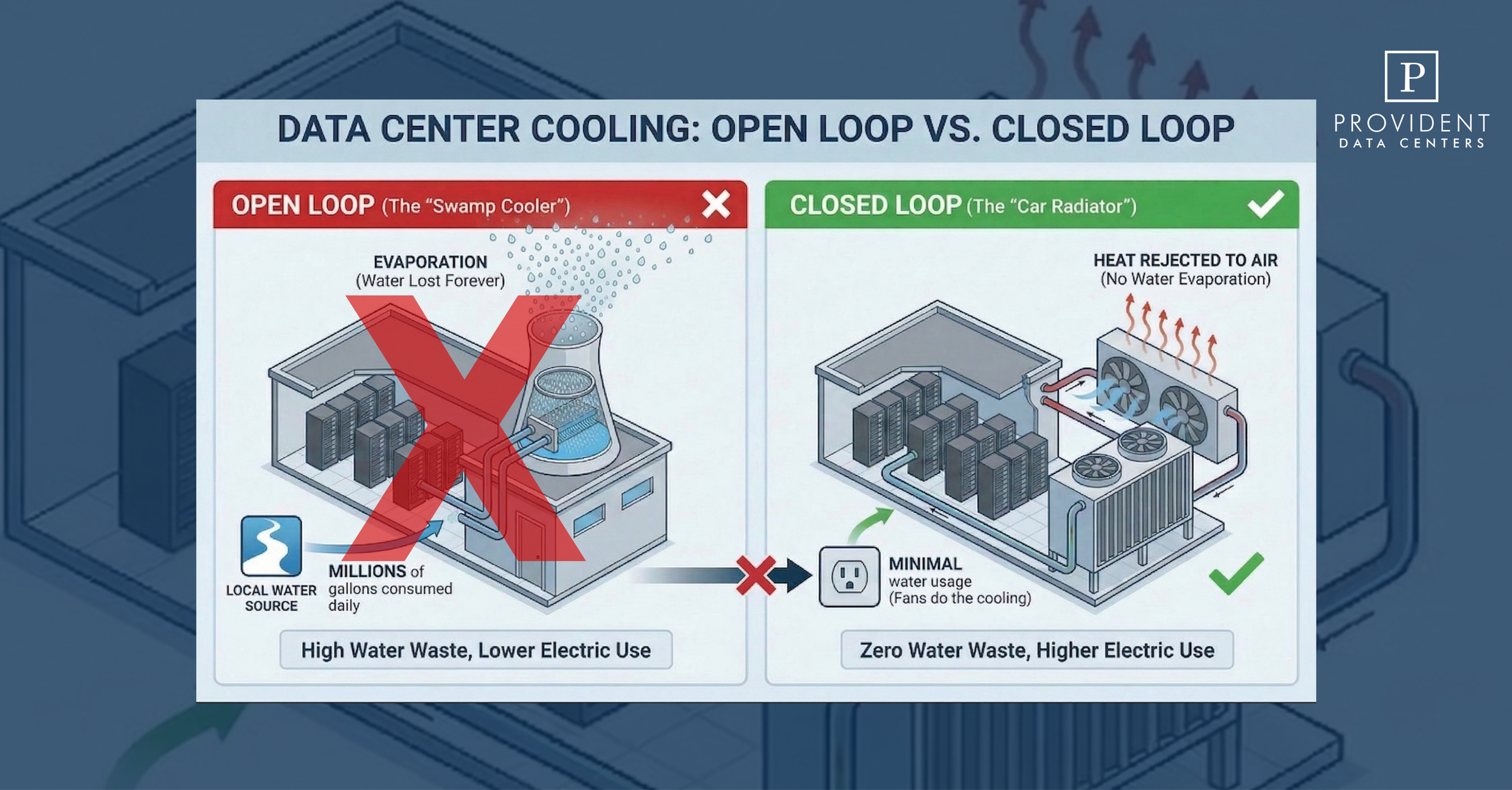
One of the most significant challenges facing the data center industry today is water consumption. Traditional cooling methods, such as evaporative cooling, are water-intensive and can place a heavy burden on local resources. The industry recognizes this challenge and is turning to a different approach - known as closed-loop cooling - a method Provident strongly supports.
In this method, water continually circulates through a closed system, resulting in drastically reduced water usage as compared to traditional cooling modalities. Not only does closed loop cooling require very minimal water usage, it is also better at controlling surging heat from today’s high-performance computing. These factors, low water use and enhanced temperature control, have made closed loop cooling the “go-to” resource for industry construction. Statistics illustrate the trend. As of 2026, roughly 25% to 30% of all new global data center build-outs are incorporating some form of advanced closed-loop liquid cooling (Direct-to-Chip or Immersion), a massive jump from less than 5% just a few years ago.
The percentages are even higher for major hyperscalers. In the massive campuses being built for Google, Microsoft and Meta, over 50% of new capacity is now designed with closed-loop cooling, according to industry research. Meanwhile, in data centers purpose–built for AI, the use of closed loop liquid cooling is projected to be 70% to 100%.
Demystifying Closed Loop Liquid Cooling
Unlike traditional air cooling, which relies on fans and heat sinks to dissipate heat, liquid cooling involves circulating coolants (such as water or special cooling fluids) across computer components to remove and absorb excess heat and offers many advantages. For one, liquid cooling utilizes the fact that water and other liquids are far more efficient at transferring heat than air -- anywhere between 50 and 1,000 times more efficient. This efficiency translates into the ability to better cool high-temperature GPUs and ultra-high-density racks, thereby reducing overall energy consumption and enabling a smaller data center physical footprint. In terms of water usage, closed loop cooling uses small amounts of water compared to traditional cooling systems.
Liquid cooling is generally categorized into two primary types:. Direct-to-Chip (D2C) Liquid Cooling, also known as cold plate cooling, which is a targeted solution that brings coolants into direct contact with computing equipment, allowing for much faster and more effective heat transfer. Second is Immersion Cooling which involves submerging entire servers or IT equipment into a tank filled with water or a specialized, non-conductive (dielectric) liquid. The heated fluid is pumped to a heat exchanger for cooling before being recirculated.
As noted in industry benchmarks from technology partners like Vertiv, direct-to-chip cooling is essential for managing the extreme thermal loads of modern GPU clusters. This precision cooling ensures that data centers can maintain 100% uptime and performance while significantly reducing the energy required for air movement. Also, because direct-to-chip cooling systems are entirely sealed, the water does not evaporate, allowing the delivery of high-density power without the massive water resource consumption of traditional data center cooling.
Reducing Water Usage
The impact of shifting to a closed-loop system is best understood through a direct comparison with residential usage. A typical data center utilizing traditional evaporative cooling can consume as much water as a small city. In contrast, a Provident Data Centers facility using a closed-loop system dramatically slashes that footprint. For example, one of our campus facilities currently under construction will use less water than 100 homes and an AI Inference facility would be closer to the water usage of 5 homes. This represents only a tiny fraction of what current permitted uses would typically allow for an industrial site of this scale. For local government officials and economic development personnel, we’ve found this statistic is a game-changer. It demonstrates that closed-loop data centers can bring billions in economic benefits including high-paying jobs and significant tax revenue without straining the local water table or forcing residents to face water restrictions.
Zero Public Sewer Discharge: A Commitment to Local Infrastructure
Water consumption is only one half of the environmental equation; the other is wastewater management. Traditional cooling towers often discharge "blowdown" water - water that has become concentrated with minerals and treatment chemicals - into the public sewer system. This places additional stress on local municipal treatment plants and can lead to increased costs for the city. At Provident Data Centers, we support closed-loop facility designs that ensure that none of the water used for cooling is discharged into the public sewer. Instead, we partner with certified disposal companies to collect and manage any necessary fluid changes offsite. The fluid exchanges required for closed loop systems are infrequent, every 10 – 15 years+.
Building a Future Where Digital Growth and Community Interests Align
Our mission is to establish long-lasting partnerships where all parties can thrive and prosper together. We achieve this by sharing best practices that prove environmental stewardship and high performance are not mutually exclusive. For our financial and investment partners, our commitment to closed-loop cooling and lifecycle design enhances the long-term value and viability of our assets. By maintaining rigorous performance standards and uptime reliability, we de-risk the investment while meeting strict ESG criteria. Our systems provide the density required for AI workloads without the risk of excessive resource consumption.
